
Remote Personnel Accountability in Oil & Gas | LivePOB
Remote work is part of everyday Oil & Gas operations.
Crews may be working on pipelines, construction projects, maintenance activities, or temporary locations far from the main facility.
But when an emergency happens, distance creates an important question:
How quickly can you account for everyone working remotely?
During one inspection visit, LivePOB Founder M. Bakir Tailor encountered a situation that exposed just how difficult that question can become.
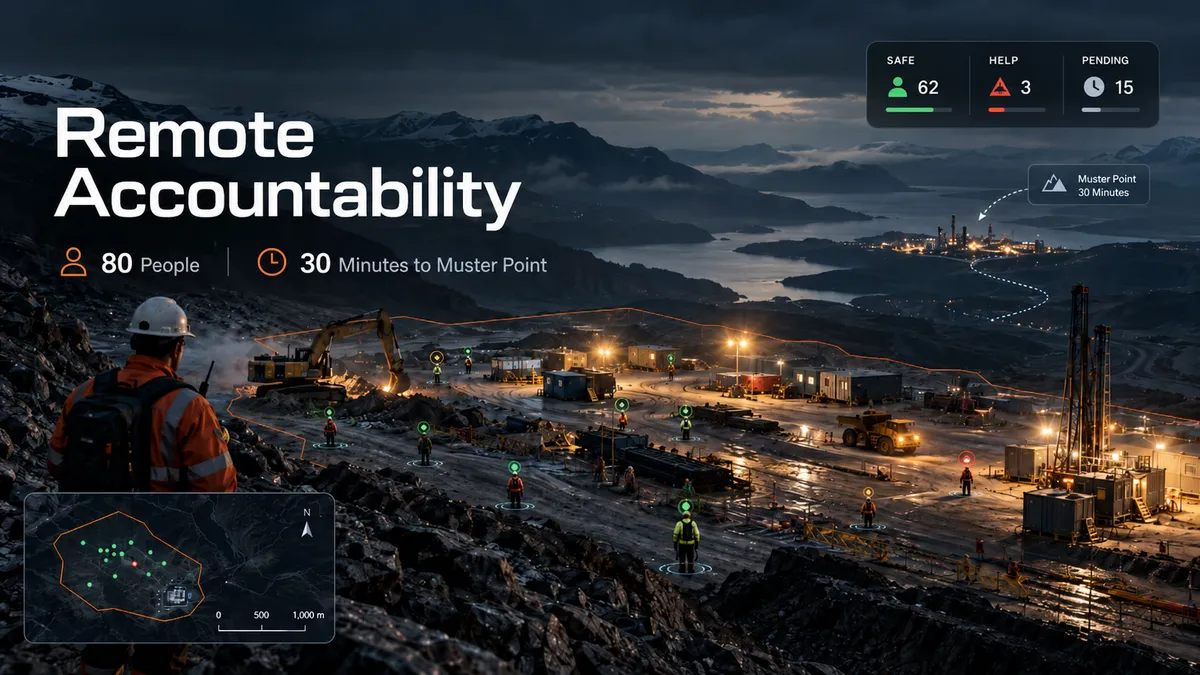
Around 30 employees and 50 contractors were working at a remote dam construction location.
Almost 80 people.
They were approximately 30 minutes from the nearest muster point, with only one or two handheld radios available for emergency communication.
Then came a simple question:
If a real emergency happened right now, how would you account for everyone here?
“We Would Find Out About Them Later”
The radios could potentially allow the staff to inform HSE that they were safe.
But what about the roughly 50 contractors?
The foreman's answer was direct:
“Good luck. We would find out about them later. We don't know their names.”
The problem wasn't negligence.
Contractor crews changed frequently. A list prepared at the beginning of the week could quickly become outdated. Even with a fresh roster, engineers could not realistically be expected to remember every contractor working at the location.
Yet the emergency plan for nearly 80 people depended on two radios—and finding out about some of them later.
That exposed a bigger personnel accountability problem.
Remote Work Shouldn't Mean Remote Accountability
Traditional emergency processes are often built around the main facility.
There are established gates, known operational areas, access systems, and designated muster points.
But Oil & Gas operations extend far beyond those boundaries.
Remote crews, pipeline teams, contractors, temporary work areas, and mobile operations may all be part of the workforce on any given day.
So an effective personnel accountability process needs to answer three questions:
Who is actually working there today?
Can their status be confirmed without waiting for them to return?
Can HSE see them as part of the same accountability picture as personnel at the main facility?
If those answers depend on remembering names, finding the latest spreadsheet, contacting a supervisor, or physically returning to a muster point, distance can become a serious accountability gap.
The Lesson That Shaped LivePOB
The foreman's statement—“We don't know their names”—became an important design principle behind LivePOB.
Personnel accountability should not depend on someone knowing every person's name in advance.
With LivePOB, identity stays connected to the individual as they become part of the operational picture. A remote work location can be represented as an operational zone, allowing employees and contractors to establish recorded presence there.
Then, when personnel accountability is required, they can deliberately report their status without first having to return to the main facility.
The objective is not continuous phone tracking.
It is creating useful recorded operational context and enabling personnel to confirm their status when it matters.
That means distinguishing between:
Recorded Presence — who was recorded as part of the operation.
and
Confirmed Status — who has reported SAFE, who needs HELP, and whose status remains UNRESOLVED.
Test Your Own Remote Operations
Before your next emergency drill, choose one remote crew and ask:
1. Do we know who is actually there today?
Not who was scheduled last week. Who is part of the operation now?
2. Can they confirm their status without returning to the main facility?
If the nearest muster point is 20 or 30 minutes away, what happens during those minutes?
3. Can HSE see them within the same accountability picture?
Remote personnel should not disappear from visibility simply because they are working away from the main site.
Your Operations Extend Beyond the Main Site
The dam crew story involved nearly 80 people, a muster point 30 minutes away, and an emergency process heavily dependent on just one or two radios.
But the lesson applies to remote operations across Oil & Gas.
Think about your pipeline crews, contractors, temporary projects, remote maintenance teams, and mobile operations.
Then ask one question:
If an incident started right now, how quickly could you account for them?
Because distance from the main facility should never mean distance from your personnel accountability process.
Your operations extend beyond the main site.
Your accountability should too.
Request a LivePOB demo and discover how LivePOB can support personnel accountability across remote Oil & Gas operations.