Personnel Accountability in Oil & Gas | The LivePOB Story
Emergency systems are usually designed in meeting rooms.
Procedures are documented. Muster points are selected. Responsibilities are assigned. Drills are scheduled.
But the real test begins when an emergency refuses to follow the procedure.
For M. Bakir Tailor, Founder of LivePOB, that lesson did not come from a presentation or a theoretical risk assessment. It came from thirteen years working as a site IT manager at one of the largest gas operations in Iraq, where emergency response was not simply something discussed during drills.
During those years, the field was attacked twelve times, including four drone attacks. One of those attacks claimed the lives of four colleagues.
Those experiences eventually led to a fundamental question about personnel accountability in Oil & Gas operations:
Why should someone have to leave a safe position and move through potential danger simply to confirm that they are safe?
When the Procedure Meets the Real Emergency
Traditional emergency mustering follows a familiar model.
When the alarm sounds, personnel move to designated muster points. Once they arrive, wardens or response teams establish who is present and begin identifying those who are not.
For many emergencies, this procedure has served industry for decades.
But Bakir's experience exposed a difficult reality: not every emergency makes movement safer.
During an active security threat, personnel may already be behind cover. Moving across open ground toward a predetermined assembly point can introduce additional risk.
The very process designed to establish personnel safety can therefore require people to leave the place where they currently feel safest.
This was not a theoretical contradiction.
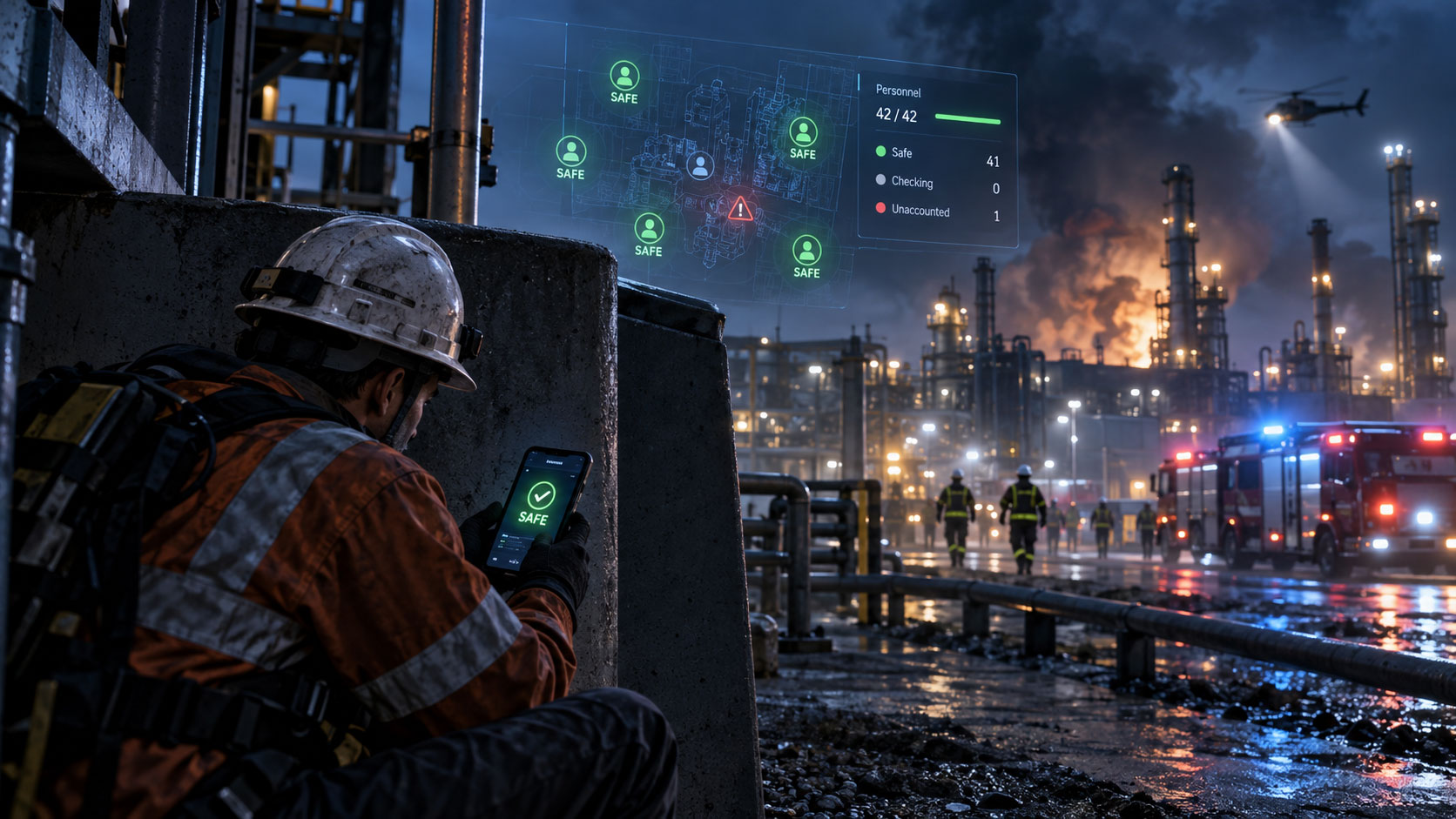
Bakir describes being under a duck-and-cover concrete slab during an attack and asking himself why there was no way to tell the organization that he was safe without standing up and moving.
That question became the beginning of LivePOB.
Thirteen Years Inside the Problem
LivePOB was not created from one incident alone.
Over thirteen years, Bakir experienced the gap between emergency procedures written under controlled conditions and what actually happens when conditions become unpredictable.
He saw thousands of employees, contractors, and visitors having to be accounted for during emergencies.
He experienced security incidents where threats remained active.
He spent sixteen months under pandemic quarantine conditions, which raised another question: how do you account for people when gathering them together is precisely what the safety procedure is trying to prevent?
And across more than 600 emergency drills, he saw how traditional processes could measure mustering performance without necessarily providing the complete personnel accountability picture.
Different situations kept exposing the same underlying limitation:
Personnel accountability depended too heavily on moving people to the count.
A Different Question for Oil & Gas Operations
The challenge is particularly important for complex Oil & Gas environments.
Personnel may be distributed across operational zones, remote works, pipelines, accommodation areas, contractor locations, and other environments where reaching a traditional muster point may take time—or may not be the safest immediate action.
So the question behind LivePOB became different.
Instead of asking:
How do we get everyone to one place so we can account for them?
The thinking became:
How can people confirm their status from where they are safest?
That distinction eventually became one of the principles behind LivePOB:
Muster where you are safest.
The objective is not to eliminate emergency movement when movement is required. Incident commanders may still need personnel to evacuate, relocate, or follow specific emergency instructions.
The difference is that movement does not have to be a prerequisite for confirming personnel status.
From a Question to LivePOB
The problem ultimately shaped the system.
LivePOB was developed to provide a different approach to personnel accountability for safety-critical operations.
During a drill or major incident, personnel can report their status rather than relying solely on physical presence at a muster point.
The accountability picture can then distinguish between personnel who have confirmed SAFE, those requesting HELP, and those whose status still requires verification.
This changes the role of the accountability process.
Instead of first moving everyone in order to establish the count, teams can begin establishing confirmed status while personnel remain where conditions allow them to be safest.
And instead of treating silence as evidence of safety, attention can be directed toward the people whose status has not yet been confirmed.
Built From Operational Reality
There is an important distinction between building emergency technology around what should happen and building it around what can happen when the plan breaks.
LivePOB grew from the second perspective.
Its founder had experienced emergencies where conditions changed rapidly, where infrastructure could not simply be assumed to remain available, and where traditional mustering requirements did not always align with the safest action for personnel.
That experience shaped a simple idea:
Personnel should not have to put themselves at greater risk simply to become a number on an accountability list.
Their ability to communicate their status should travel with them.
Personnel Accountability Should Start With People
Oil & Gas operations have changed dramatically.
Sites are larger. Workforces include employees, contractors, and visitors. Operations extend beyond facility boundaries. Security threats and other hazards can create conditions very different from those for which traditional fixed-point mustering was originally designed.
Personnel accountability therefore needs to work with the reality of modern operations.
For LivePOB, that philosophy began under a concrete slab during an actual attack, with one person asking a very practical question:
Why can't I tell them I'm safe from here?
That question eventually became a platform.
And it remains at the center of the LivePOB philosophy today:
Don't move people just to count them. Enable them to report from where they are safest—and focus the response on those who can't.
Discover how LivePOB approaches personnel accountability across complex Oil & Gas operations. Request a LivePOB demo today.