Emergency Muster Point Safety: When Gathering Adds Risk
For decades, one instruction has defined emergency mustering:
When the alarm sounds, move to the designated assembly point and be counted.
It is familiar, simple, and deeply embedded in emergency procedures across industrial operations.
And for the type of hazard it was originally designed around, it makes sense.
A fire gives personnel something to move away from. Open ground may provide a safer location, and gathering people in one designated area makes counting them possible.
But modern Oil & Gas operations face a wider range of threats.
And that raises an important question:
What happens when moving toward the muster point is not the safest action?
The Muster Point Was Designed Around Gathering
Traditional personnel accountability depends on a straightforward sequence:
Move people. Gather them. Count them.
The physical muster point therefore serves two purposes at once: it provides an assembly location and creates a practical way to establish who is accounted for.
The problem is that these two objectives are not always the same.
People may need to move because the emergency requires them to evacuate.
But should they also need to move simply because the accountability process requires everyone to gather in one place?
That distinction becomes important when the nature of the threat changes.
Not Every Emergency Makes Open Ground Safer
Oil & Gas emergency planning today must consider more than conventional fire scenarios.
The source material highlights several examples: seismic events, severe weather, toxic releases, and security threats.
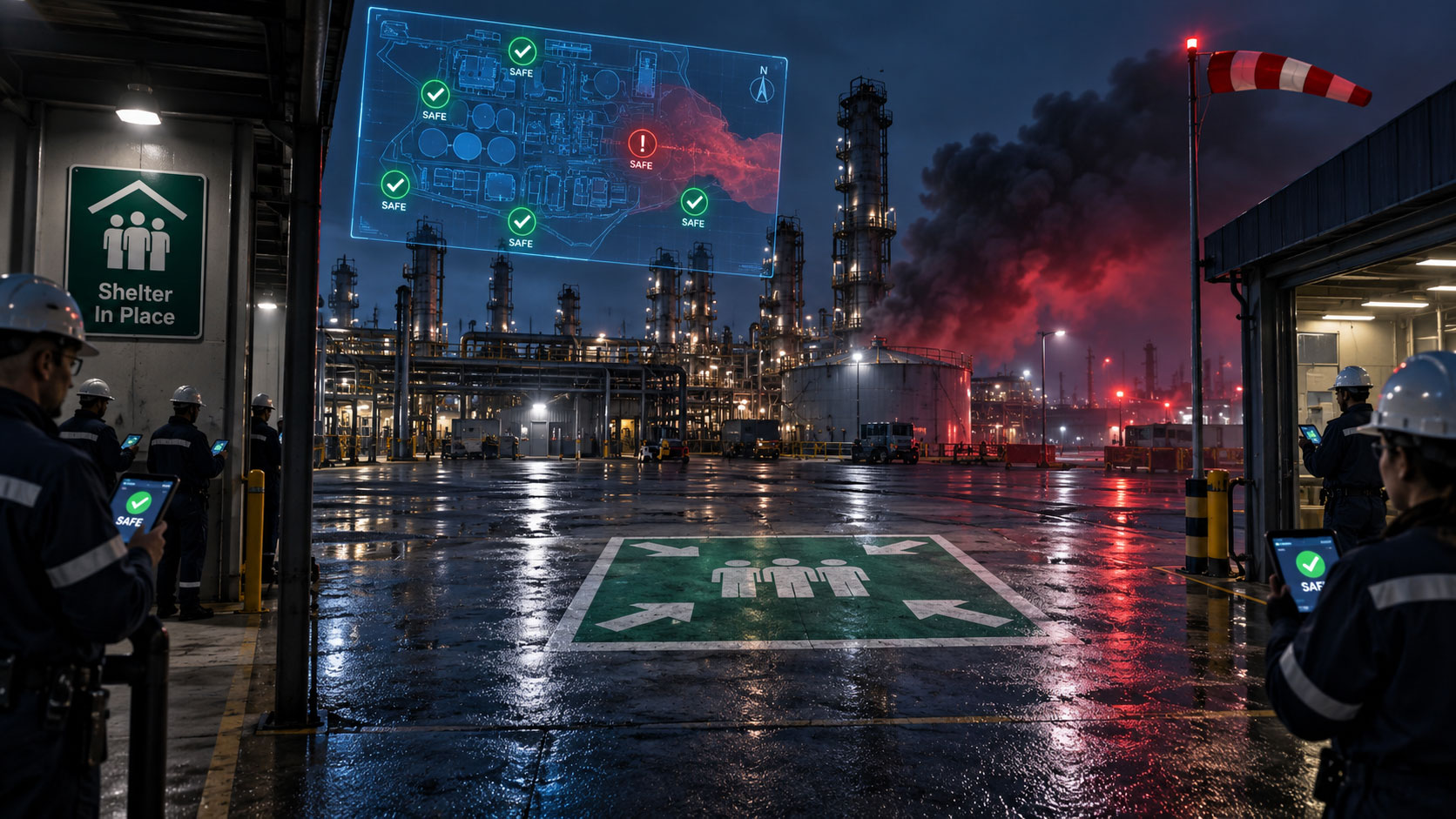
A toxic release can move with the wind—and the wind does not follow an emergency plan.
A security incident can make a predictable gathering of hundreds of people at a known location a potential risk rather than a refuge.
Severe weather or other rapidly changing conditions can also affect whether a predetermined location remains appropriate.
Yet traditional mustering can still begin with the same instruction:
Leave where you are and move toward the designated assembly area.
The procedure assumes that gathering remains compatible with safety.
Real incidents do not always respect that assumption.
When Counting Starts Driving Movement
This exposes a fundamental limitation in fixed-point personnel accountability.
Sometimes personnel are moving not because the emergency requires that movement, but because the counting process requires their physical presence somewhere else.
A worker may already be behind appropriate cover.
Another may be working far from the main facility.
A remote crew may be many minutes away from the nearest designated muster point.
In each case, physically gathering everyone may make the count easier.
But making the count easier and making personnel safer are not necessarily the same thing.
That is the operational problem LivePOB was designed to challenge.
Separate Accountability From Gathering
A different model becomes possible when personnel do not need to physically reach a fixed location simply to communicate their status.
The principle is:
Let personnel report from where they are safest—and move them when the response requires movement.
This does not mean eliminating muster points.
It means separating two decisions that traditional processes often combine:
Where should this person move for safety?
and
How do we confirm this person's status?
When those decisions are separated, the incident itself can determine whether movement is necessary.
Personnel accountability no longer has to be the reason people move.
From Fixed Muster to SelfMuster
This principle sits behind LivePOB SelfMuster.
During a drill or major incident, personnel can report SAFE or request HELP from a suitable internet-connected device.
This allows the accountability picture to begin forming without requiring every individual to first arrive at the same physical point.
Those who have confirmed SAFE can be distinguished from those requesting HELP and those whose status still requires verification.
The objective is not simply to digitize the traditional muster point.
It is to change the dependency between physical gathering and personnel accountability.
Why This Matters for Oil & Gas Operations
The distinction becomes particularly relevant in complex Oil & Gas environments.
Personnel may be distributed across processing areas, operational zones, pipelines, remote work locations, contractor works, and other locations beyond the immediate reach of a conventional assembly area.
Different hazards may also require different protective actions.
A single fixed location cannot determine what is safest for every person under every possible incident condition.
The accountability process therefore needs to support the emergency response—not dictate unnecessary movement simply because that is how people have historically been counted.
A Different Principle for Modern Personnel Accountability
The traditional model can be summarized simply:
Move people to a point. Then count them.
The alternative proposed in the source is equally simple:
Let people report from where they are safest—and go find the ones who can't.
That changes the role of personnel accountability.
The question is no longer:
“How quickly can we get everyone to the painted square?”
It becomes:
“How quickly can we establish confirmed personnel status without creating unnecessary movement through danger?”
For modern Oil & Gas operations, that is a question worth asking before the next alarm sounds.
Request a LivePOB demo and see how SelfMuster can support personnel accountability across your Oil & Gas operations.