
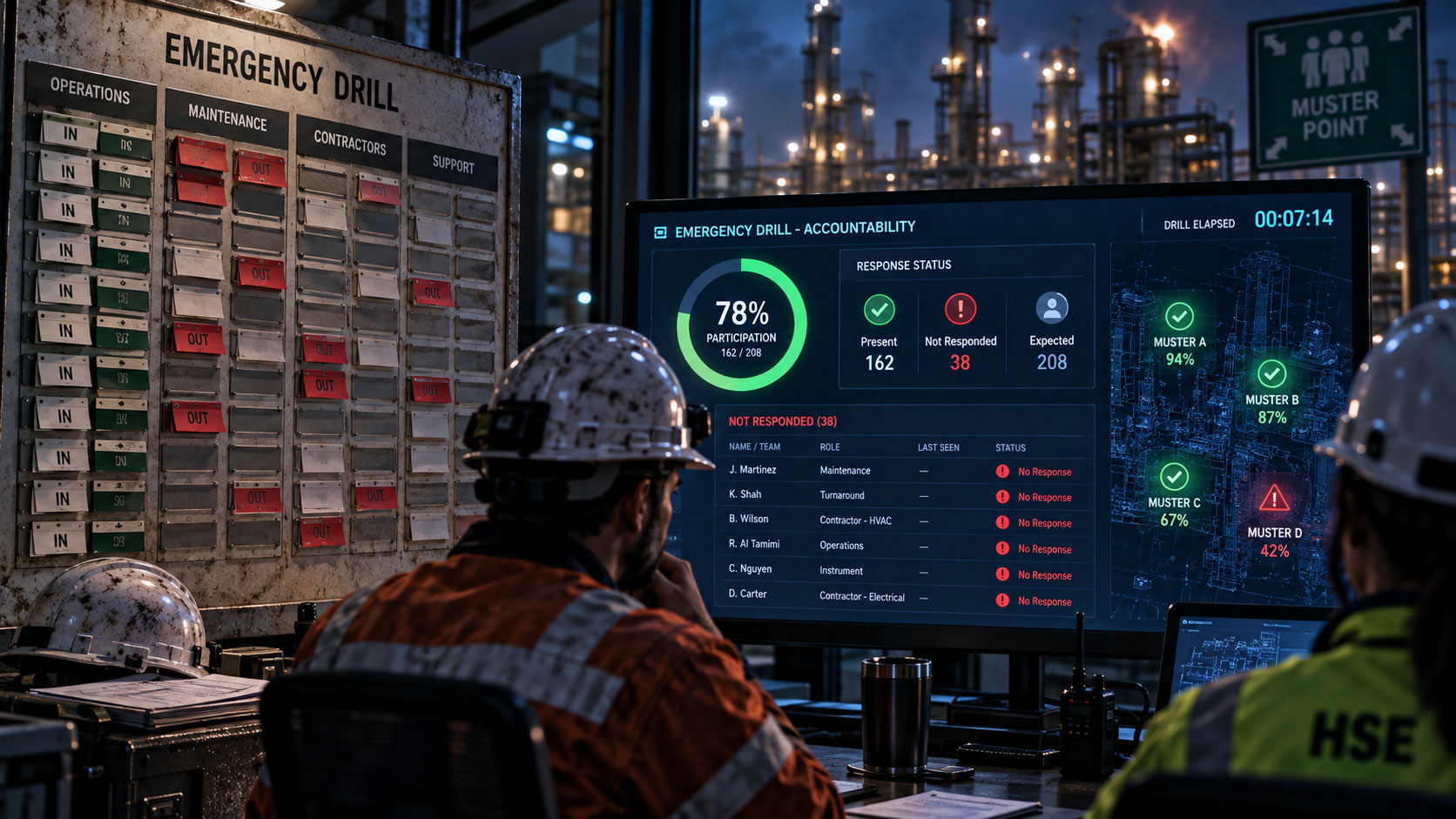
Emergency Drill Accountability: What 600+ Drills Revealed
Your emergency drill is completed in 25 minutes.
Everyone returns to work.
The result looks good.
But there is a more important question:
How many people actually participated in the count?
After observing more than 600 emergency drills, the Founder of LivePOB began questioning one of the most common ways organizations evaluate emergency mustering:
Time.
How quickly did everyone reach the muster point?
How long did the headcount take?
How fast was the all-clear given?
The best reported drill time he witnessed was approximately 25 minutes.
On paper, that sounds like success.
But the T-cards told a different story.
The Cards That Never Moved
In the traditional process described in the source, personnel were represented by physical T-cards.
During a muster, the cards should move as people are accounted for.
But across the drills the founder observed, roughly half of the T-cards never moved.
In practical terms, approximately half of the population was not participating in the drill process being measured. Yet the drill could still produce a completion time and be treated as successful.
That exposed a fundamental problem:
A fast count is only valuable if the count itself is reliable.
Speed and Accuracy Are Not the Same Thing
Emergency drills are designed to test readiness.
But if success is measured primarily by how quickly the procedure finishes, an important part of readiness can remain hidden.
Imagine a drill involving 1,000 people.
Completing the process quickly may look impressive.
But if hundreds did not participate, the completion time tells you very little about how the same process would perform during a real emergency involving the full population.
This creates two separate measurements:
How quickly did the drill finish?
and
How completely did people participate?
Without the second, the first can create false confidence.
The Real Emergency Will Not Use the Drill Population
A real incident does not exclude the people who skipped the last drill.
It does not limit itself to employees who understood the procedure.
It may involve contractors, visitors, temporary personnel, remote workers, and others who happen to be part of the operation when the incident begins.
That is why participation matters.
If an Oil & Gas facility conducts regular drills but cannot clearly identify who participated and who did not, it may be testing only part of its actual personnel accountability process.
The drill can still finish.
The report can still show a time.
But an important question remains unanswered:
Who did the system fail to hear from?
From a Drill Time to a Drill Record
This is where digital personnel accountability changes what can be measured.
With LivePOB, a drill can provide more than a final completion time.
Personnel reporting creates a named and timestamped record of participation.
Instead of simply knowing that the drill ended, HSE teams can review who confirmed their status and whose status remained UNRESOLVED.
That creates a different level of operational evidence.
The organization can begin asking:
Who responded?
Who did not?
How quickly were statuses reported?
Where are the recurring gaps?
Are the same people, teams, or operational areas repeatedly failing to participate?
Now the drill is not simply an exercise.
It becomes a source of measurable information.
Why Non-Participation Matters
Someone who does not participate in a drill may expose a weakness that matters during a real incident.
Perhaps they did not receive the instruction.
Perhaps they did not understand what to do.
Perhaps their operational location made participation difficult.
Perhaps a contractor population was not properly included.
Or perhaps the accountability process itself has a gap.
The reason cannot simply be assumed.
But once non-participation is visible by name, HSE teams have something specific to investigate and improve.
Without that visibility, the same gap can remain hidden from one drill to the next.
Better Drills Create Better Emergency Readiness
The purpose of a drill should not be to produce the fastest possible number for a report.
It should be to reveal whether the accountability process will work when the organization genuinely needs it.
That means measuring more than speed.
It means measuring participation, response, unresolved statuses, and recurring gaps.
Over time, those records can help organizations understand whether emergency readiness is actually improving rather than simply whether drill completion times are becoming shorter.
For complex Oil & Gas operations, where employees, contractors, visitors, and remote personnel may all need to be accounted for, that distinction becomes especially important.
Measure What Matters
A 25-minute drill can look successful.
But if half of the expected population never participated, the time alone does not tell the full story.
That is the lesson behind The T-Card That Never Moved.
The question Oil & Gas leaders should ask after their next drill is not only:
“How fast did we finish?”
It should also be:
“Can we prove who actually participated?”
Because emergency readiness should not be measured by speed alone.
It should be measured by the reliability of the personnel accountability picture behind it.
Request a LivePOB demo and see how digital personnel accountability can turn emergency drills into measurable operational evidence.