
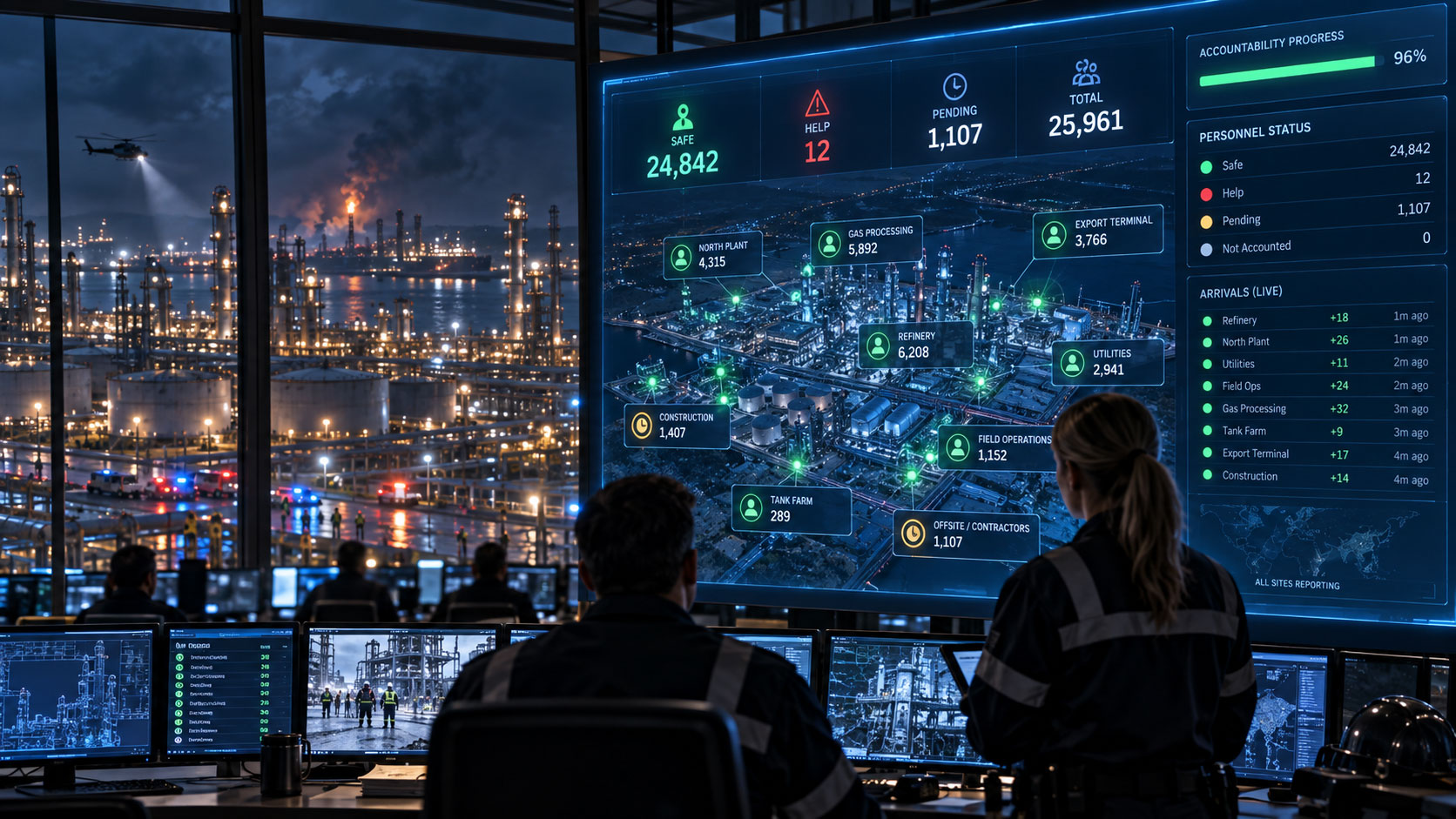
Emergency Accountability for Large Workforces | LivePOB
When an emergency starts, every person needs to be accounted for.
For a site with a few hundred people, a traditional warden-based muster process may appear manageable.
But what happens when the workforce reaches thousands—or tens of thousands—across a complex operation?
At that scale, personnel accountability becomes more than a procedural challenge.
It becomes a numbers problem.
The 75,000-Person Question
In one example described by the Founder of LivePOB, a company with more than 75,000 employees explained that its emergency mustering process depended on wardens.
At first, that may sound like a familiar and established approach.
Then comes the arithmetic.
If one warden is responsible for approximately 200 to 300 people, a workforce of 75,000 requires around 250 to 375 wardens.
But wardens are employees too.
They work shifts. They take leave. They become ill. They change roles or leave the organization.
Once shift coverage and absences are considered, the source estimates that maintaining the process could require approximately 400 to 750 trained, current, drill-ready personnel capable of performing the warden role.
At that point, emergency counting begins to resemble an operation of its own.
The Challenge Is Not the Warden
This is an important distinction.
The problem is not that wardens are ineffective.
Wardens can play an important role in emergency response.
The challenge is the architecture of a process that depends on information passing sequentially through people.
On a large Oil & Gas operation, hundreds of wardens cannot realistically communicate directly with a single incident controller.
So layers begin to form.
Wardens report to area marshals.
Area marshals report to zone controllers.
Zone controllers report upward to the incident command structure.
The result can be three or four layers of human communication between the person being counted and the team trying to establish the site-wide accountability picture.
One Delayed Report Can Delay the Bigger Picture
This creates another challenge.
The complete personnel accountability picture cannot be established until information has moved through the reporting structure.
If one branch is delayed, its information remains incomplete.
During a routine drill, that may mean waiting longer for the final count.
During a real emergency, the implications are more serious.
HSE, Security, and Operations leaders need to understand:
Who has confirmed SAFE?
Who needs HELP?
And whose status remains unresolved?
The longer it takes to establish that picture, the longer decision-makers may have to operate with incomplete information.
For large and complex Oil & Gas operations, this becomes a scalability issue.
What Happens to Accuracy at Scale?
Speed is only one side of the problem.
The other is accuracy.
The original story asks the reader to imagine an extremely generous 99% accuracy rate across a workforce of 75,000.
A one-percent error at that scale represents 750 potentially incorrect statuses.
That could mean people appearing present when they are not, or people appearing absent when they are actually somewhere else.
The lesson is not that a particular warden will make an error.
It is that even a very small error rate becomes significant when multiplied across a very large workforce.
This is particularly important in Oil & Gas operations where the accountability population may include not only employees, but also contractors, visitors, rotating crews, and personnel distributed across multiple operational areas.
From Sequential Reporting to Parallel Reporting
This is where the underlying model can change.
Instead of asking hundreds of wardens to collect information and relay it upward through several layers, personnel can participate directly in establishing their own status.
This is one of the principles behind LivePOB SelfMuster.
During a drill or major incident, personnel can report SAFE or request HELP, allowing reports to arrive in parallel rather than waiting for one long human reporting chain to complete.
The significance is scalability.
Five hundred people do not necessarily need five hundred sequential conversations.
And seventy-five thousand people do not need their status passed through hundreds of human intermediaries before leadership can begin seeing the accountability picture.
The Warden's Role Can Change
Modernizing personnel accountability does not have to mean eliminating wardens.
It means removing the need for wardens to function primarily as a human data-transfer network.
Their attention can instead remain on the responsibilities where human judgment matters most: supporting personnel, identifying hazards, assisting emergency response, and dealing with exceptions on the ground.
Meanwhile, the accountability picture can develop directly as individual statuses are reported.
This changes the model from:
People → Wardens → Marshals → Controllers → Incident Command
to a much more direct flow of confirmed personnel status.
A Scalability Question for Oil & Gas Leaders
For HSE and Operations leaders, the question is therefore not simply:
“Does our muster procedure work?”
A more useful question is:
“What happens to our muster procedure when the number of people, sites, contractors, zones, and reporting layers increases?”
A process that works adequately for 500 people may behave very differently at 5,000, 20,000, or 75,000.
And during an emergency, scalability is not simply an IT requirement.
It directly affects how quickly leadership can establish a reliable personnel accountability picture.
The original story summarizes the difference clearly: a traditional warden structure performs a parallel problem through a serial human-relay network. Self-reporting changes that architecture by allowing many individual statuses to arrive in parallel.
For large Oil & Gas operations, that can mean moving from a process that becomes increasingly complex as the workforce grows to one designed to establish confirmed status at scale.
Request a LivePOB demo and see how SelfMuster can support personnel accountability across large and complex Oil & Gas operations.