
Emergency Accountability During Infrastructure Failure | LivePOB
Every emergency system is designed around one promise:
It will work when you need it most.
But the real test does not happen during a presentation or a normal drill.
It happens when the emergency begins taking other systems down with it.
In November 2025, an operating gas plant faced exactly that situation.
At night, a hostile drone struck the facility.
An NGL tank ignited.
The plant entered emergency shutdown.
Then the infrastructure began to fail.
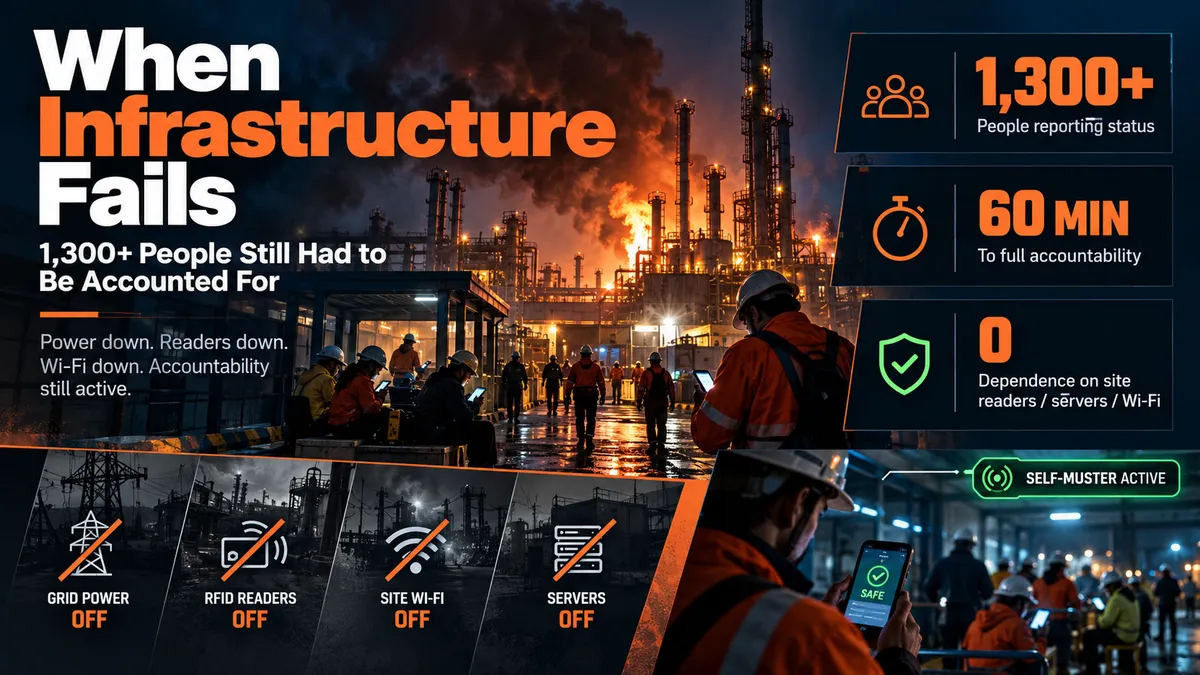
And more than 1,300 employees, contractors, and visitors still needed to be accounted for.
The Emergency Didn't Take Down One System
Grid power went down.
With it went RFID readers, on-premises servers, and Wi-Fi access points across the site.
Even backup power did not make the situation simple. The book describes UPS failures, with some failures also affecting network switches.
This revealed an important reality about major incidents:
Systems do not always fail individually or in the sequence anticipated in a redundancy plan.
One failure can affect another.
And suddenly, the technology your emergency process expects to use may be affected by the same incident you are trying to manage.
What Does Your Accountability Process Depend On?
This raises a question every HSE, Security, Operations, and IT team should consider:
What has to remain operational for your personnel accountability process to work?
Power?
Local network infrastructure?
On-site servers?
Readers?
Fixed terminals?
A dedicated emergency device?
If several of those dependencies became unavailable at the same time, could you still establish who was SAFE, who needed HELP, and whose status remained UNRESOLVED?
That is a very different test from asking whether the system works under normal operating conditions.
More Than 1,300 People Were Still Out There
While infrastructure was affected, the people did not disappear.
More than 1,300 employees, contractors, and visitors were across the operation, sheltering according to the conditions around them.
They still needed a way to become part of the accountability picture.
According to the account in WHY LIVEPOB — What's In It For Me, personnel used their own phones to report while sheltering. The reporting path used mobile carrier connectivity rather than the affected on-site infrastructure.
There was no need to form muster lines under an active threat simply to complete the count.
People could shelter and report.
And within 60 minutes, more than 1,300 employees, contractors, and visitors had declared themselves SAFE.
The Remaining Names Became the Priority
But the value of personnel accountability is not simply producing a large SAFE number.
It is identifying the people whose status is still unknown.
As reporting progressed, the remaining unresolved records became a specific, named list that could be investigated and closed.
Instead of searching everywhere, response attention could be directed toward the people who still required verification.
That is an important shift:
From counting everyone to identifying who still needs attention.
Test the Failure, Not Just the Alarm
Emergency drills often test the incident scenario.
But do they also test the dependencies behind the accountability process?
For your next exercise, consider asking:
What if grid power is unavailable?
What if the local network is affected?
What if readers or on-site servers cannot be reached?
Can personnel still deliberately report their status?
Can the response team still identify the unresolved population?
Because the hardest emergency may not leave your supporting infrastructure untouched.
Resilience Is About Dependencies
The lesson from November 2025 is not that every facility will experience the same sequence of failures.
It is that personnel accountability should be examined under degraded conditions, not only ideal ones.
LivePOB's core SelfMuster workflow is designed so that emergency status reporting does not depend on proprietary on-ground emergency hardware.
That design mattered on a night when multiple parts of the site's infrastructure were affected—and more than 1,300 people still needed to be accounted for.
Don't only ask whether your accountability system works.
Ask what it depends on to keep working.
Request a LivePOB demo and see how personnel accountability can be designed for the moments when normal site conditions no longer apply.