
Confirmed Safety vs Expected Location | LivePOB
During an emergency, knowing where someone is supposed to be can feel reassuring.
The roster says they are in a certain area.
A supervisor remembers where they were assigned.
A medic knows they are in their room.
So it becomes easy to make one dangerous leap:
“We know where he is. He must be fine.”
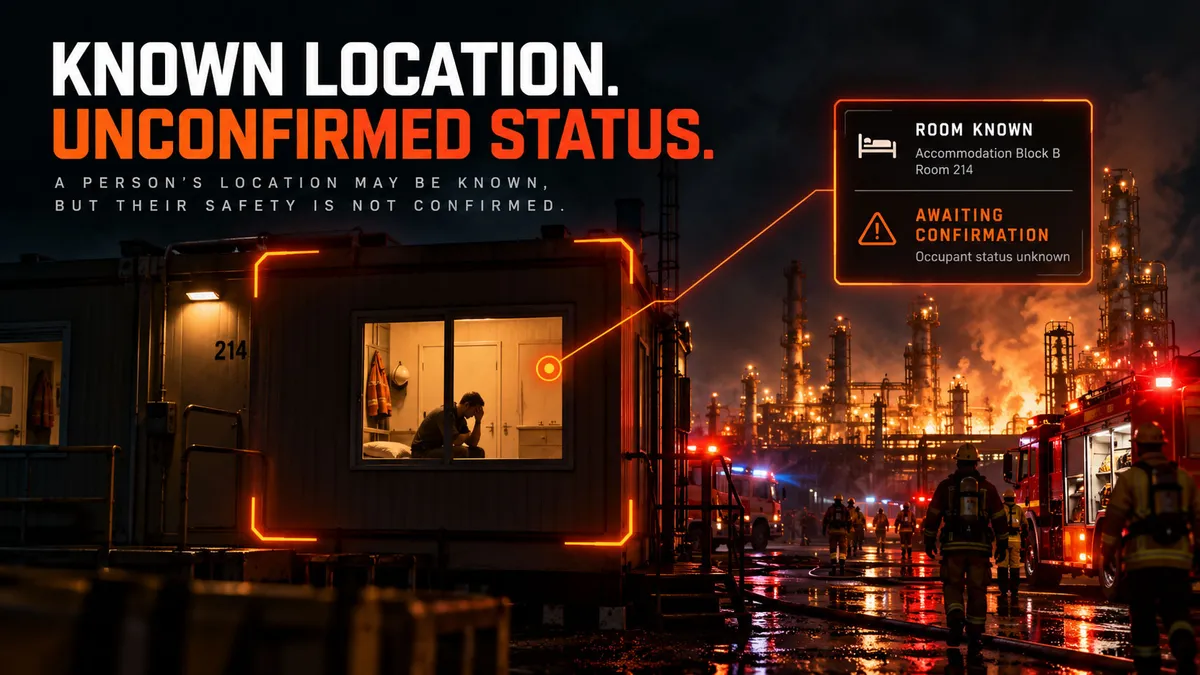
But expected location and confirmed safety are not the same thing.
One experience from LivePOB Founder M. Bakir Tailor demonstrates exactly why.
One Man Couldn't Join the Muster
During the pandemic, an employee who became contagious could be instructed to remain isolated in his accommodation.
Door closed.
Food delivered.
Medical support provided.
The procedure existed for a good reason: protect the employee and everyone around him.
Then came a rocket attack.
Sirens sounded across the site. Personnel responded, sheltered, or participated in the accountability process.
Except for one man.
He was sick and alone in his cabin, under medical instructions not to leave.
He could not go to the muster point.
And the systems available at the time gave him no direct way to report his actual status.
So how was he accounted for?
“The Medic Knows He's in His Room.”
Bakir witnessed the same answer more than once:
His status was assumed.
The medic knew the employee was supposed to be in his room.
Therefore, he was treated as fine.
But nobody had actually heard from him.
The team knew his expected location.
They did not know his confirmed status.
Think about the situation from the employee's perspective.
He was sick.
He was alone.
He had been instructed not to leave.
And now he was listening to explosions outside his accommodation.
If he was safe, the response team needed to know.
If he needed help, they needed to know that even more.
Yet the process had effectively replaced his voice with an assumption.
“Probably Fine” Is Not a Status
This is where personnel accountability can become dangerously optimistic.
Someone is expected to be in the office.
Another worker was last seen in a workshop.
A contractor is scheduled to be off site.
A supervisor believes someone has already left.
All of those pieces of information may provide useful context.
None of them independently confirms SAFE.
As the book puts it:
“Assumed fine is not a status. It is a hope, filed as a fact.”
That distinction became fundamental to the thinking behind LivePOB.
Let the Person Confirm Their Status
With LivePOB, someone who must remain in place does not need to physically reach a muster point simply to become part of the accountability picture.
From a suitable connected device, they can deliberately report:
SAFE
or
HELP
The person in isolation can remain where the safety or medical procedure requires while still communicating their status.
In the original story, this is the key transformation: isolation removes the employee from physical contact, but it does not have to remove him from personnel accountability.
And the principle extends far beyond medical isolation.
A worker may be sheltering in place.
Someone may be injured and waiting for assistance.
Personnel may be inside a lockdown area.
Others may be unable to move because of the incident itself.
Their inability to reach a muster point should not automatically become an inability to report their status.
Turn Silence Into an Action
There is another important principle here.
No response should not automatically mean SAFE.
At the beginning of an incident, LivePOB distinguishes between personnel who have confirmed SAFE, those who have reported HELP, and those whose status remains UNRESOLVED.
That gives response teams something actionable:
Who still requires verification?
Instead of filling information gaps with assumptions, the unresolved population becomes part of the response team's follow-up.
Ask One Question During Your Next Drill
When someone is marked safe, ask:
How do we actually know?
Did that person confirm their status?
Was their status verified?
Or did someone simply assume they were fine because they knew where the person was supposed to be?
Because during an emergency:
Expected location is context.
Confirmed status is accountability.
Don't start with assumptions. Start with confirmed status.
Request a LivePOB demo and see how LivePOB can help your team build a clearer personnel accountability picture when every status matters.