
Confined Space Personnel Accountability | LivePOB
In Oil & Gas operations, a confined-space permit can tell you a lot.
Who is authorized to enter.
Whether they have the required training.
Whether gas tests were completed.
Whether the necessary approvals were signed.
But there is another question that becomes critical when something goes wrong:
Who is actually inside right now?
That distinction between what the paperwork says and what is happening on the ground is the lesson behind one of the stories that shaped LivePOB.
The Permit Wasn't the Problem
A permit-to-work system has an important job.
For confined spaces such as tanks, vessels, and pits, it establishes who may enter and whether the required conditions have been met.
But authorization and actual presence are not the same thing.
As LivePOB Founder M. Bakir Tailor describes in WHY LIVEPOB — What's In It For Me:
The permit knows who may enter. It does not know who did. It does not know who came out.
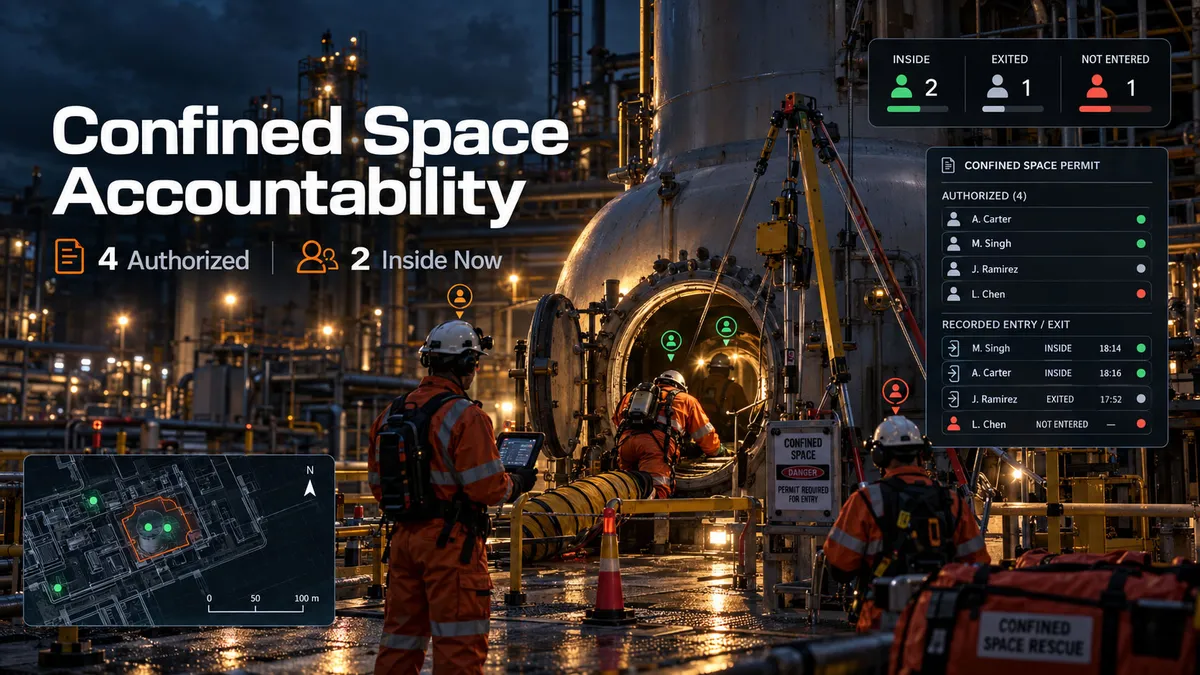
Imagine four people listed on a confined-space permit.
All four are authorized.
But perhaps only three entered.
One came out 20 minutes ago.
Another entered later.
Now an emergency alarm sounds.
How many people are actually inside?
The answer cannot safely come from the permit alone.
When Paper and Reality Become Two Different Pictures
This is where a seemingly small information gap becomes operationally important.
The permit provides one picture:
Who is authorized to enter?
The response team needs another:
Who actually entered—and who has not yet exited?
Without recorded entry and exit events, that answer may need to be reconstructed from a permit, a whiteboard, or the memory of whoever is managing the entry point.
Under normal conditions, that gap may appear manageable.
During an incident, it can become a very different problem.
If an alarm sounds while work is underway, the incident commander should not have to begin by asking:
“Was anyone inside the tank?”
The response should begin with the clearest recorded operational picture available.
From Authorization to Recorded Presence
This is one of the operational problems LivePOB was designed to address.
A confined space can be represented as a defined operational zone.
As personnel enter and exit, those movements can be recorded against their identities.
The result is not continuous GPS tracking.
It is something much more specific:
A named, timestamped record of entry and exit.
If two people entered at 14:12 and 14:31 and no exit has yet been recorded for either person, the response team has useful operational context immediately. The original story describes exactly this scenario: instead of asking whether someone might still be inside, the incident commander can begin with the two recorded names and their entry times.
That changes the starting point of the response.
The rescue plan starts with a list instead of a question.
Why Time Matters Too
Confined-space operations are not only about knowing who entered.
Duration can matter as well.
The book describes how recorded entry times can make the duration of an individual's presence visible, allowing teams to identify when someone is approaching a defined time limit rather than relying only on memory.
This creates another useful distinction:
A permit documents authorization.
Recorded zone transactions provide operational evidence of presence.
Both have value.
But they answer different questions.
Ask This Before Your Next Confined-Space Job
Take one confined-space operation at your facility and test the process.
If an emergency happened halfway through the work, could your team immediately answer:
Who was authorized to enter?
Who actually entered?
Who has already exited?
Who has no recorded exit yet?
And could you answer those questions from recorded information rather than assumptions or memory?
Because during an emergency, the difference between “four people were authorized” and “two people are recorded as still inside” is not a small detail.
It can completely change where the response begins.
The Permit Says Who May. The Record Shows Who Did.
Strong permit-to-work procedures remain essential.
The lesson is not to replace them.
It is to recognize what they can—and cannot—confirm.
A permit tells you who may enter.
Your operational visibility should help establish who did.
And when an incident happens, that difference matters.
Request a LivePOB demo and see how recorded operational zones can add another layer of personnel visibility to your Oil & Gas operations.